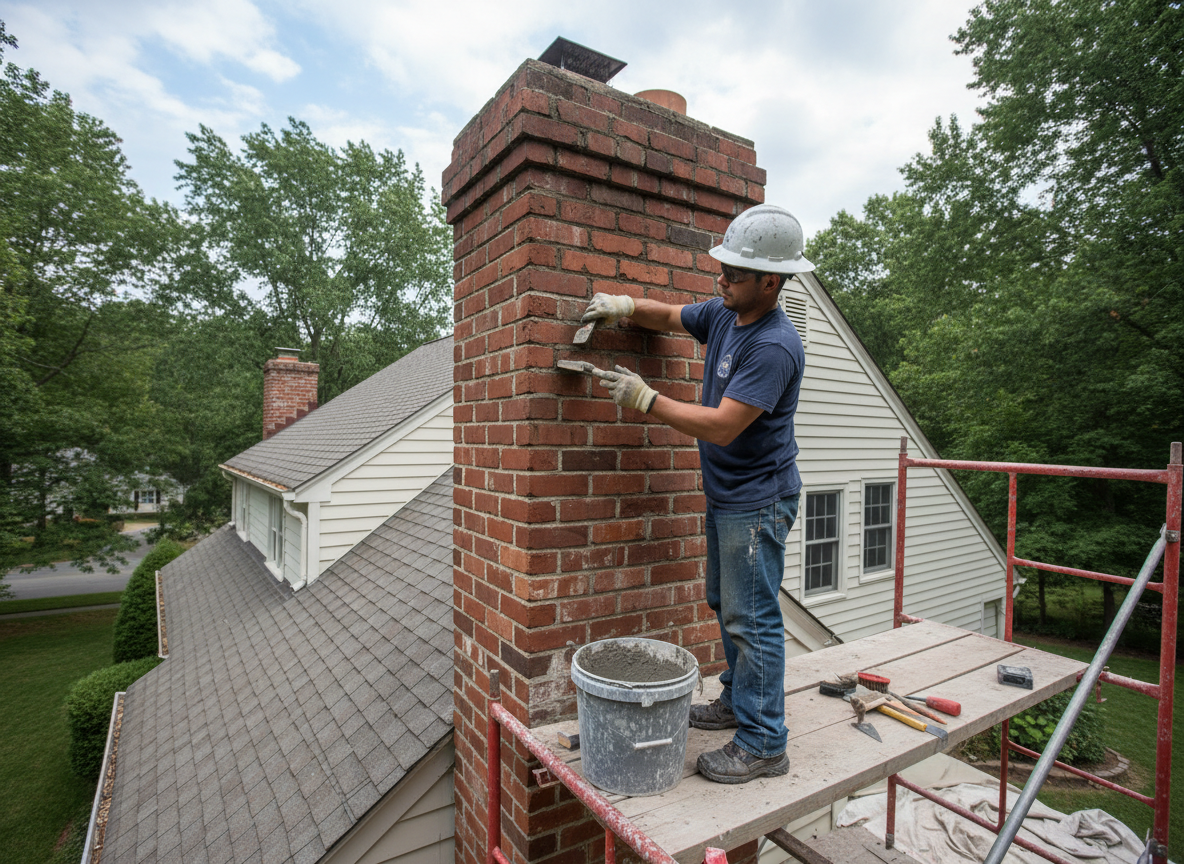
Tuckpointing requires removing deteriorated mortar to a consistent depth before packing in fresh lime-based mortar that matches the original color and texture. In Parsippany-Troy Hills many chimneys from the 1960s and 1970s sit on split-level and ranch homes where the flue runs through unheated attic space, so temperature swings accelerate joint failure along the north-facing side.
Homeowners often notice white efflorescence or small gaps near the roofline first. We use a grinder with dust extraction followed by hand chisels to avoid damaging the brick faces common on local homes. New mortar is tooled to shed water away from the joint, and we check for loose flue tiles that can shift once the surrounding mortar is disturbed.
Edge cases include chimneys built with soft common brick that crumbles if mortar is removed too aggressively, and those with prior cement repairs that must be fully cut out because cement traps moisture against the brick. We also inspect the crown and flashing at the roof deck because water entering at those points will ruin new tuckpointing within two winters.
Seasonal Timing
Tuckpointing in Parsippany-Troy Hills is best done between late spring and early fall so the mortar can cure before the first hard freeze. Jobs started after October risk incomplete curing when daytime highs drop below 50 degrees.
Technician insight
In Parsippany-Troy Hills, the thing that catches most people out with chimney tuckpointing is the north-facing wall on 1960s split-levels where freeze-thaw cycles hit hardest because the chimney sits in shade most of the day and the mortar never fully dries between storms.
Loose Joints on a Cedar Knolls Chimney
Homeowner noticed white powder and small gaps near the roof on a 1972 split-level. We found the north side mortar had washed out to 1 inch depth while the south side remained sound. We removed and repacked only the damaged joints with matching mortar and confirmed the crown was still intact.
How it works
- 1
Site Inspection
We examine every joint from the roofline to the crown, noting water entry points and brick condition on homes in neighborhoods like Lake Hiawatha and Cedar Knolls.
- 2
Mortar Removal
Old mortar is cut out to 3/4 inch depth using dust-controlled grinders and chisels while protecting roofing and siding.
- 3
Joint Packing
Fresh mortar is pressed in layers and tooled to match existing profiles, ensuring a slight outward slope on horizontal joints.
- 4
Cleanup and Cure Check
Excess mortar is removed from brick faces and the chimney is monitored for the first 48 hours to confirm proper curing before we leave the site.
Pricing
Cost depends on chimney height, number of sides requiring work, and access on two-story homes common in Parsippany-Troy Hills.