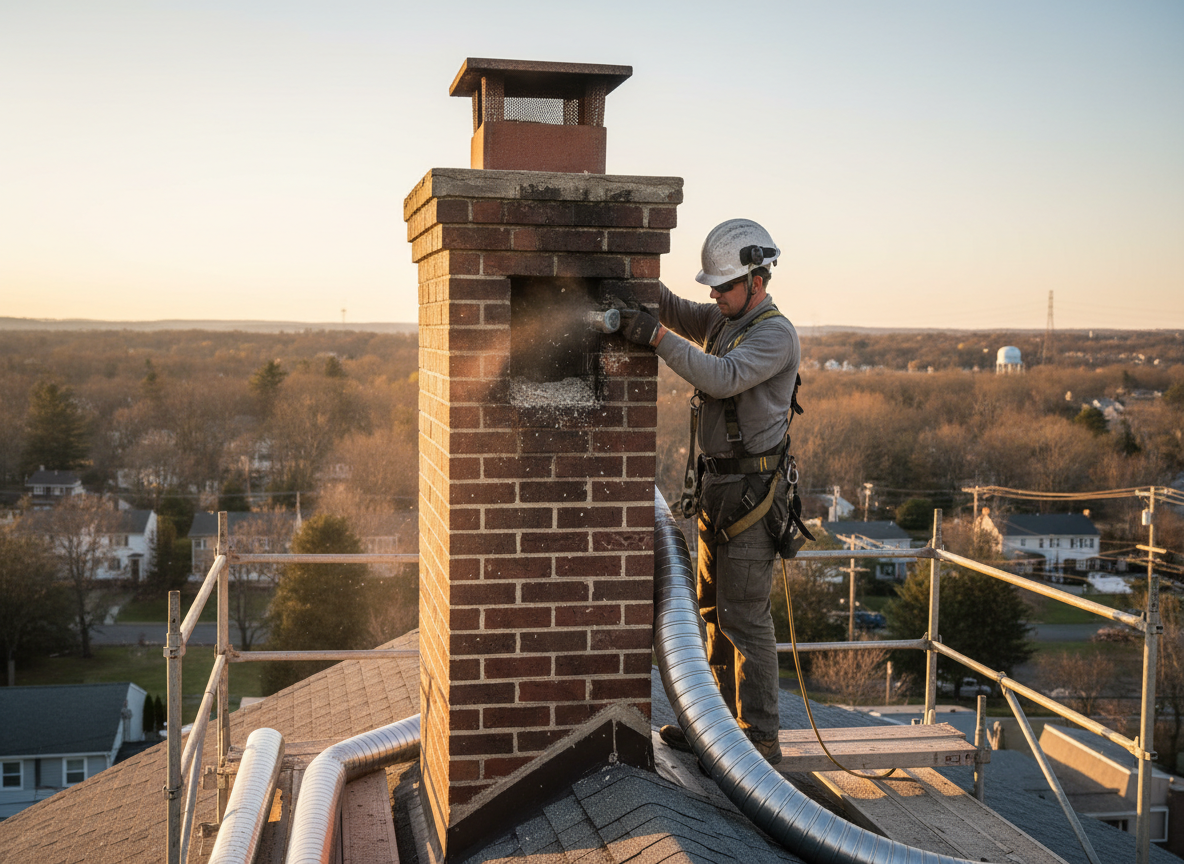
Chimney liners in Parsippany-Troy Hills homes often fail from repeated freeze-thaw cycles that stress clay or early stainless inserts installed in the 1960s and 1970s housing stock. When water penetrates the flue and expands, hairline cracks widen quickly, allowing carbon monoxide and creosote to leak into living spaces. Repair work here requires pulling the old liner through the roof chase while protecting cedar shake or asphalt roofs common on split-level and ranch homes along routes like Route 46 and I-80.
Stainless steel or cast-in-place liners are the two options that meet current New Jersey fuel-gas code for gas or oil appliances in this area. Cast-in-place works better on chimneys with multiple offsets found in many Troy Hills two-story colonials, but it demands precise mixing to avoid voids that trap moisture against the brick. Access is frequently limited by tight attic spaces and low-slope roofs, so technicians must stage equipment on the ground at 35 Waterview Blvd before driving to the job.
Edge cases include shared flues in attached townhomes near Lake Parsippany and liners that have separated at the smoke chamber joint after decades of settling on the glacial till soils typical of Morris County. Homeowners sometimes attempt DIY patch kits that fail within one winter, leaving the flue non-compliant and requiring full removal anyway. Proper repair always includes a post-install camera sweep to confirm the new liner runs straight and seals at both the top and cleanout.
Technician insight
In Parsippany-Troy Hills, the thing that catches most people out with chimney liner repair is the way older clay liners in pre-1980 split-levels crack along the back wall where the flue runs close to the exterior brick; one winter of ice expansion and the separation lets exhaust into the second-floor bedrooms before anyone notices the smell.
Separated Liner in Troy Hills Colonial
Homeowner noticed faint exhaust odor on the second floor during a cold snap. Inspection showed the clay liner had pulled away at the smoke chamber joint in a 1972 colonial off Beverwyck Road. We removed the damaged sections through the roof, installed a continuous stainless liner sized for the oil furnace, and sealed the crown. The odor disappeared and the system passed the post-repair draft test.
How it works
- 1
Initial Camera Inspection
Technician scopes the full flue length from cleanout to crown to locate cracks, separations, or creosote buildup.
- 2
Liner Assessment and Material Selection
Determine whether stainless steel insert or cast-in-place is appropriate based on chimney offsets and appliance type.
- 3
Old Liner Removal
Carefully extract the damaged liner through the roof or cleanout while protecting surrounding masonry and roofing.
- 4
New Liner Installation and Testing
Install the replacement liner, seal connections, and perform a final camera inspection plus draft test.
Pricing
Cost depends on liner material, chimney height, and access difficulty; call 24/7 for an on-site assessment.